By Christophe Romei
MWC 2026 marked a structural shift: AI is no longer a keynote talking point, it is becoming the operational backbone of telecom networks. Here are the signals that telecom decision-makers cannot afford to miss.
AI moves into the network core and operators are acting
The biggest break at this MWC was not technological, it was organizational. SK Telecom announced a full redesign of its network core around AI. ZTE and partners demonstrated Level 4 autonomous networks through Agentic AI. Telefónica deployed an AI digital twin to optimize energy efficiency across its datacenters — a concrete, measurable, profitable use case.
The message is unambiguous: CSPs stuck at autonomy levels 1-2, dashboards and isolated pilots are falling behind. The front-runners are targeting Level 4, which involves real-time cross-layer decision-making, with operational cost reductions estimated at up to 30%. Without a Standalone (SA) architecture in place, any AI-network strategy remains cosmetic.
According to Rakuten, AI is transforming network operations by shifting from a reactive to a predictive and autonomous model. Through AIOps, real-time data analysis and autonomous agents, networks can now anticipate failures, self-heal and automatically optimize customer experience.
5G monetization pivots: from megabits to outcomes
Ericsson articulated what the industry has sensed for two years: 5G ROI will not come from throughput — it will come from enterprise value. Guaranteed connectivity calls that never drop, stadium-grade experience, zero interruption in industrial settings these are the monetizable promises.
The four-stage model presented at MWC maps the trajectory clearly: coverage, differentiated performance, new enablers (APIs, slices), and finally measurable outcomes, fraud prevention, automation, AI workflows. Standardized APIs scale better than bespoke network projects. That is the lesson product teams at operators need to internalize now.
6G: evolution, not revolution but the race Is On
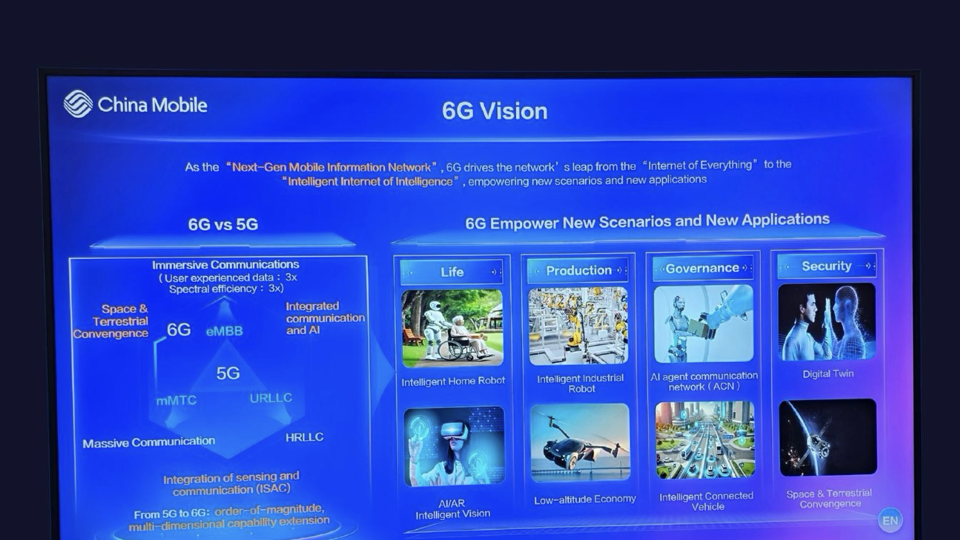
6G did not arrive at MWC 2026 as a disruption. It is being built as a continuation of 5G SA, AI-RAN, and NTN integration. China Mobile showcased its 6G Open Testbed with over 15 pilot stations, combining communication, sensing, computing, and AI, targeting what it calls the leap from the « Internet of Everything » to the « Intelligent Internet of Intelligence. »
The geopolitical dimension is explicit. Germany exhibited under the banner « Technological Sovereignty for Europe, Made in Germany. » 6G is as much a battle over industrial standards as it is a network performance story.
Satellites & NTN: Universal Coverage Takes Shape, With Real Limits
The NTN announcements were numerous,Deutsche Telekom/Starlink D2D partnership, Satellite Connect Europe (Vodafone, Orange, Telefónica), Qualcomm’s first Release 19 modem unifying cellular and satellite. But sober analysis is needed. D2D today is limited to SMS and narrow emergency use cases, still hampered by high latency and insufficient spectrum. The 300 million people currently out of mobile coverage represent a potential, not yet a commercial reality. Internet satellite and D2D mobile may share the same constellations, but they deliver radically different experiences do not conflate them in your deployment scenarios.
The Gap That Cannot Be Ignored: From Promise to Production
The industry’s stated goal « zero-touch, zero-wait, zero-trouble » networks is ambitious. Getting there requires breaking down organizational silos between RAN, core, IT and operations; building genuine trust in AI delegation among ops teams; and designing robust guardrails for unknown failure scenarios. KT Corporation pointed in the right direction with its self-evolving multi-agent system. The question of accountability when Level 4 or 5 fails remains entirely open.
MWC 2026 confirms that telecom AI has moved from experimental to structural. Decision-makers waiting for a comfortable consensus risk falling two technology cycles behind.
Extract Digest4Day — Strategic intelligence for telecom leaders