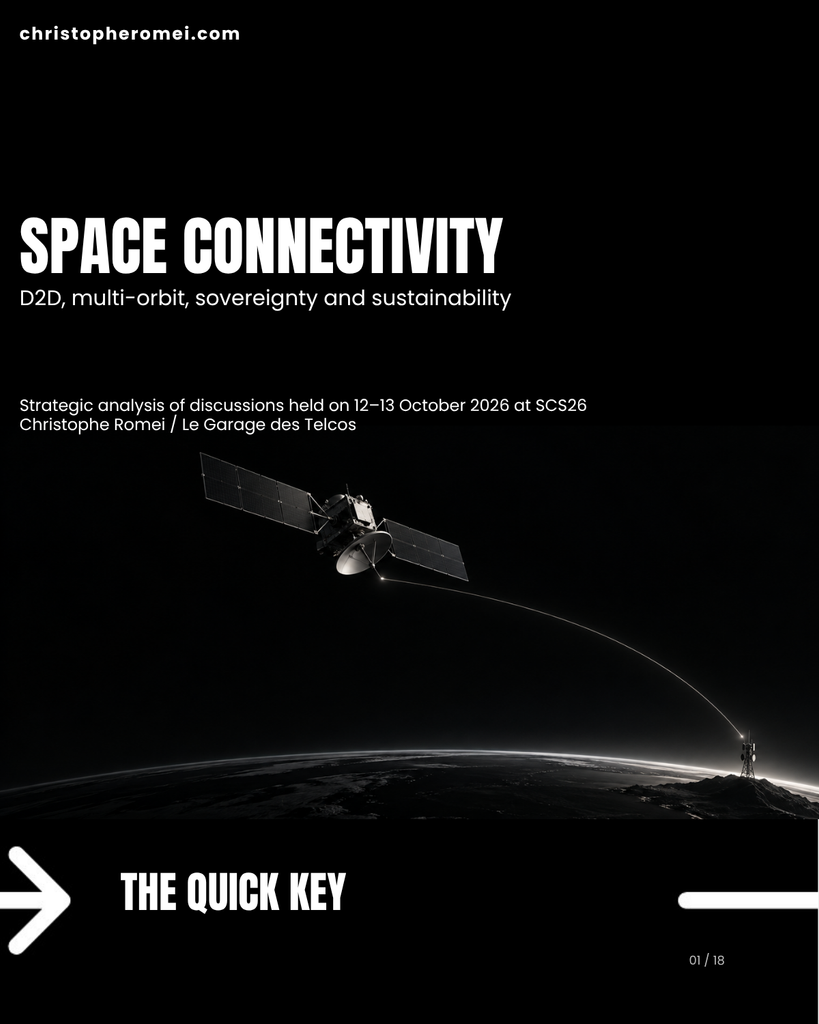
The race for space connectivity is accelerating. Satellite constellations are expanding, ordinary smartphones are beginning to connect directly to satellites, and mobile operators are looking to extend their networks. Behind the announcements lies a question: how can broader coverage become reliable services and sustainable revenue?
This is the central theme of “Space Connectivity: Direct-to-Device, Multi-Orbit, Sovereignty and Sustainability”, a strategic report drawing on discussions at the 2026 Global Space Connectivity & Sustainability Events, co-organized by Saudi Arabia’s CST and the International Telecommunication Union. The event brings together regulators, manufacturers, space service providers and researchers to explore the integration of terrestrial and non-terrestrial networks.
A strategic perspective for decision-makers
The report is designed for telecom operators, equipment manufacturers, space companies and investors seeking to understand the commercial implications of this transformation. It combines an executive summary, four thematic chapters and twenty business insights, with implications for services, partnerships and investment decisions.
The first question concerns access. Coverage does not automatically create customers. Pricing, devices, distribution and service quality determine adoption. Satellite connectivity therefore needs to address a specific use case and a demand that customers or funding partners can support.
The report then examines multi-orbit architectures and Direct-to-Device connectivity. GEO, MEO and LEO networks can address different requirements, including enterprise applications, mobility, coverage extension and emergency communications. For telecom operators, value depends as much on integration and customer relationships as on purchased satellite capacity.
Dependencies that can change the business case
Sovereignty is another major theme. Control over data, ground stations and operations involves different requirements. The report helps decision-makers ask the right questions before selecting an infrastructure model or a partner.
Launch availability also shapes commercial timelines. Delays can postpone revenue after substantial expenditure has already been committed. This dependency deserves explicit consideration when assessing projects and deployment plans.
Space sustainability directly affects service continuity. Collision avoidance, interference management, orbital data sharing and end-of-life planning all contribute to protecting assets. Changes to coexistence rules can also affect usable capacity and operating conditions.
The objective is to distinguish announced ambitions, operational experience and available evidence, then translate them into decisions. The report provides practical questions for assessing an offer, comparing partners and understanding investment risks. It also highlights where financial evidence remains insufficient to validate the business case.
Receive the contents and a sample
The report is available as an individual edition, with a team licence and the option of a dedicated briefing for your company.
To receive the table of contents and a free sample, simply send me “SATELLITE” via LinkedIn private message or through my contact page. I’ll share the materials and details of the option best suited to your needs.